
Vessel
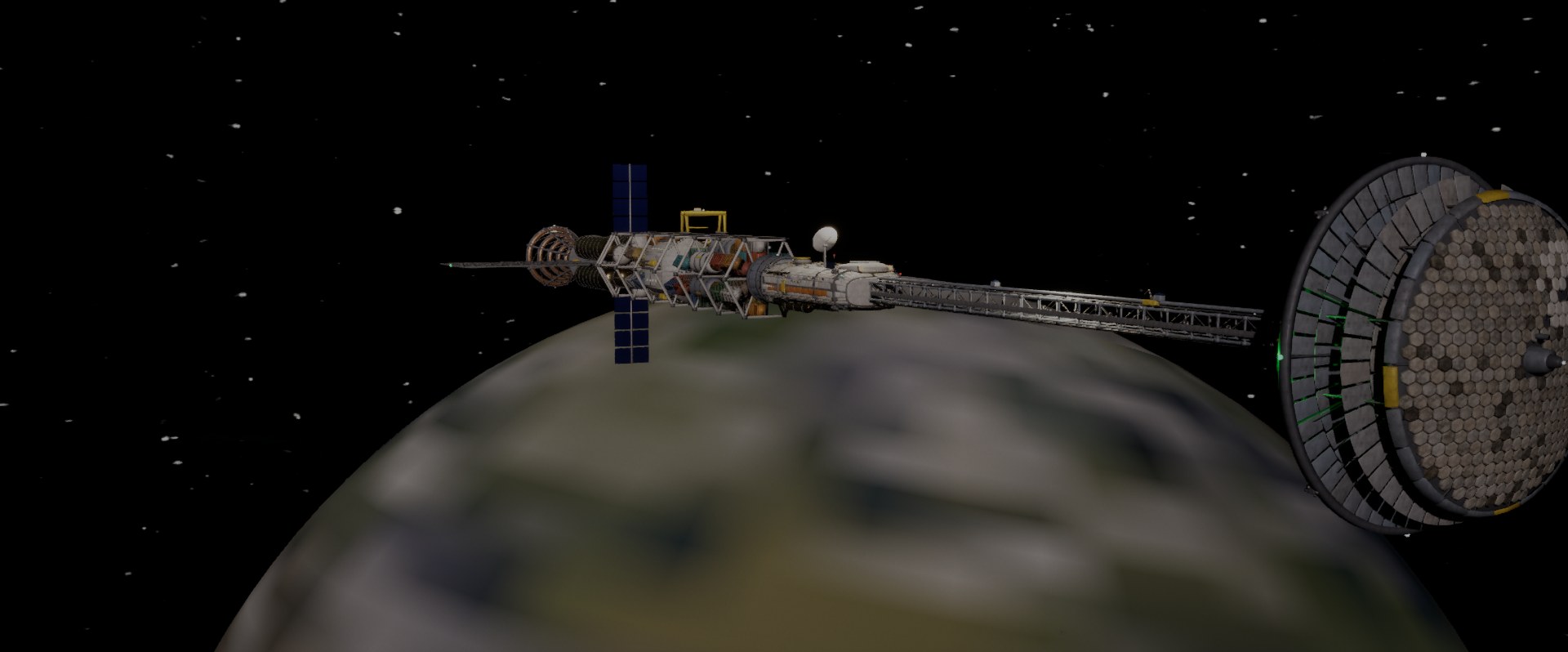
ESV Meridian
Crossing
84 years
Orbit
Nova Eridani
Crew
1–4 players
  • In development
  • Showcase 01 — Arrival
  • Private testing
Latest · 31 October 2026A home in the habitat

Prologue · 4 min 54 s in the game

Prologue · narrated cinematic · rendered in-engine

Earth ran out of time

Scroll to begin

I · Earth

By the end of the twenty-second century, we could send a ship to another star.

Back on Earth, things had been getting worse for decades. Everyone knew it, even if they didn't always want to admit it.

But on an evening like this, you could still believe we'd sort it out.

Nobody ever really agreed on how the war started. It was over in less than a week, and what it left behind lasted for generations.

For days afterwards, something kept falling from the sky. People thought it was snow. I suppose they wanted it to be.

It was fallout. The smoke from the fires had gone so high that the sun hardly got through, and the harvests failed, year after year.

Then the power started failing. Hospitals, water treatment, transport — everything we depended on. Eventually, people began abandoning the cities.

By then, if you wanted any hope at all, you had to look a very long way off.

II · Discovery

We'd found Nova Eridani long before any of that, back when finding it was simply good science.

It had water, air and signs of life, and some people wondered whether ours could take hold there too, given a few centuries.

Nobody imagined we'd need the answer so soon.

III · Genesis

So, years before the war, while there was still time to be patient, we sent a ship to find out.

Genesis carried no crew. It carried seeds and frozen plant embryos, soil bacteria and fungi, and algae and plankton for the sea and the rivers.

There were libraries of genetic records for anything too complicated to send alive. And the machines needed to bring those samples to the surface, cultivate them and look after them.

Decades later, Genesis reached a world that had been alive for a very long time.

IV · The trial

The machines started small, with test plots ashore and sealed enclosures in the bay, to see what the native microbes made of ours, and ours of them.

Most of those early trials failed. Some things died within days, and some only lived because the machines kept nursing them.

It took years of preparation before the machines finally planted a tree outside their controlled environment.

That one lived.

V · What grew

Out in the bay, the algae and plankton began to establish themselves, laying the foundations for something more complex.

None of it replaced the native life. Earth's plants and microbes grew in among it, and not always the way anyone expected.

What's down there now isn't a second Earth, and I'm not sure it should be. It's part ours and part its own, and we understand far less of it than we'd like.

VI · The Meridian

The first report from Genesis took more than ten years to reach Earth, and by then there was very little left to act on it with.

More reports followed, regular as clockwork, for years. Then, without any warning, they stopped, and nobody ever found out why.

There was no time to design a colony ship, so they took a freighter that was still being built in orbit and taught her to be one.

They gave her a shield, landers and robots, workshops and stores, a recovery suite for the people who'd wake at the other end, and an intelligence capable of keeping everything running while they slept.

She was never designed for this, and the people who finished her knew it. But she was one of humanity's last hopes of survival, so they did it anyway, and they did it well.

The crossing took eighty-four years, and nobody was awake for it except the ship.

Late in the crossing we ran into debris nobody had charted, and she came out of it worse than she looks. But we're here, and as far as I can tell, her cargo came through intact.

Genesis has had nearly another century to work since its last report reached Earth. By now the forests should have spread, and there ought to be more life in the sea. The air might even be safe to breathe. I'd rather we tested that before anyone takes their helmet off, though.

Right. Time to wake someone up.

End of the prologue

Nova Eridani has been waiting

01The premise

Earth ran out of time. Nova Eridani has been waiting.

Earth is dying. The ESV Meridian, a freighter finished in a hurry as a colony ship, has crossed 84 years of space to Nova Eridani, a world where an uncrewed precursor ship planted Earth's first forests long before. You wake in orbit to a damaged ship and Melanie, its blinded onboard intelligence. Repair her senses, reach the surface, and lay the foundations of a colony with the robots you build.

Mission file

Genre
First-person survival and colony building
Players
Alone, or up to four in co-op
The ship
ESV Meridian, 84 years out from Earth
The world
16 × 16 km, seeded with Earth forests
Status
In development · Showcase 01 — Arrival · Private testing

Wake the ship. Reach the world. Build what comes after.

00The prologue · rendered in-engine

Watch it from the start
01 · EarthBy the end of the twenty-second century, we could send a ship to another star.02 · EarthNobody ever really agreed on how the war started. It was over in less than a week, and what it left behind lasted for generations.03 · EarthFor days afterwards, something kept falling from the sky. People thought it was snow. I suppose they wanted it to be.04 · EarthThen the power started failing. Hospitals, water treatment, transport — everything we depended on. Eventually, people began abandoning the cities.05 · EarthBy then, if you wanted any hope at all, you had to look a very long way off.06 · DiscoveryWe'd found Nova Eridani long before any of that, back when finding it was simply good science.07 · DiscoveryIt had water, air and signs of life, and some people wondered whether ours could take hold there too, given a few centuries.08 · DiscoveryNobody imagined we'd need the answer so soon.09 · GenesisSo, years before the war, while there was still time to be patient, we sent a ship to find out.10 · GenesisGenesis carried no crew. It carried seeds and frozen plant embryos, soil bacteria and fungi, and algae and plankton for the sea and the rivers.11 · GenesisThere were libraries of genetic records for anything too complicated to send alive. And the machines needed to bring those samples to the surface, cultivate them and look after them.12 · GenesisDecades later, Genesis reached a world that had been alive for a very long time.13 · The trialThe machines started small, with test plots ashore and sealed enclosures in the bay, to see what the native microbes made of ours, and ours of them.14 · The trialMost of those early trials failed. Some things died within days, and some only lived because the machines kept nursing them.15 · The trialIt took years of preparation before the machines finally planted a tree outside their controlled environment.16 · What grewOut in the bay, the algae and plankton began to establish themselves, laying the foundations for something more complex.17 · What grewNone of it replaced the native life. Earth's plants and microbes grew in among it, and not always the way anyone expected.18 · What grewWhat's down there now isn't a second Earth, and I'm not sure it should be. It's part ours and part its own, and we understand far less of it than we'd like.19 · The MeridianThe first report from Genesis took more than ten years to reach Earth, and by then there was very little left to act on it with.20 · The MeridianThere was no time to design a colony ship, so they took a freighter that was still being built in orbit and taught her to be one.21 · The MeridianShe was never designed for this, and the people who finished her knew it. But she was one of humanity's last hopes of survival, so they did it anyway, and they did it well.22 · The MeridianLate in the crossing we ran into debris nobody had charted, and she came out of it worse than she looks. But we're here, and as far as I can tell, her cargo came through intact.23 · The MeridianGenesis has had nearly another century to work since its last report reached Earth. By now the forests should have spread, and there ought to be more life in the sea. The air might even be safe to breathe. I'd rather we tested that before anyone takes their helmet off, though.

02Captures from the in-development build

From the build

Straight from the game as it stands today. Nothing here is a mock-up, and every image says where it comes from.

A recovery bay seen from the cradle, the title ESV MERIDIAN on screen.

You wake in the recovery suite.

01The ship

Restore a blinded AI's senses one by one, from a damaged terminal to the ship's intercom to your suit radio.

More in the gallery
  • The descent · recorded in game

    Recorded live in the game, with sound and Melanie's narration. Work in progress.

  • After dark · recorded in game

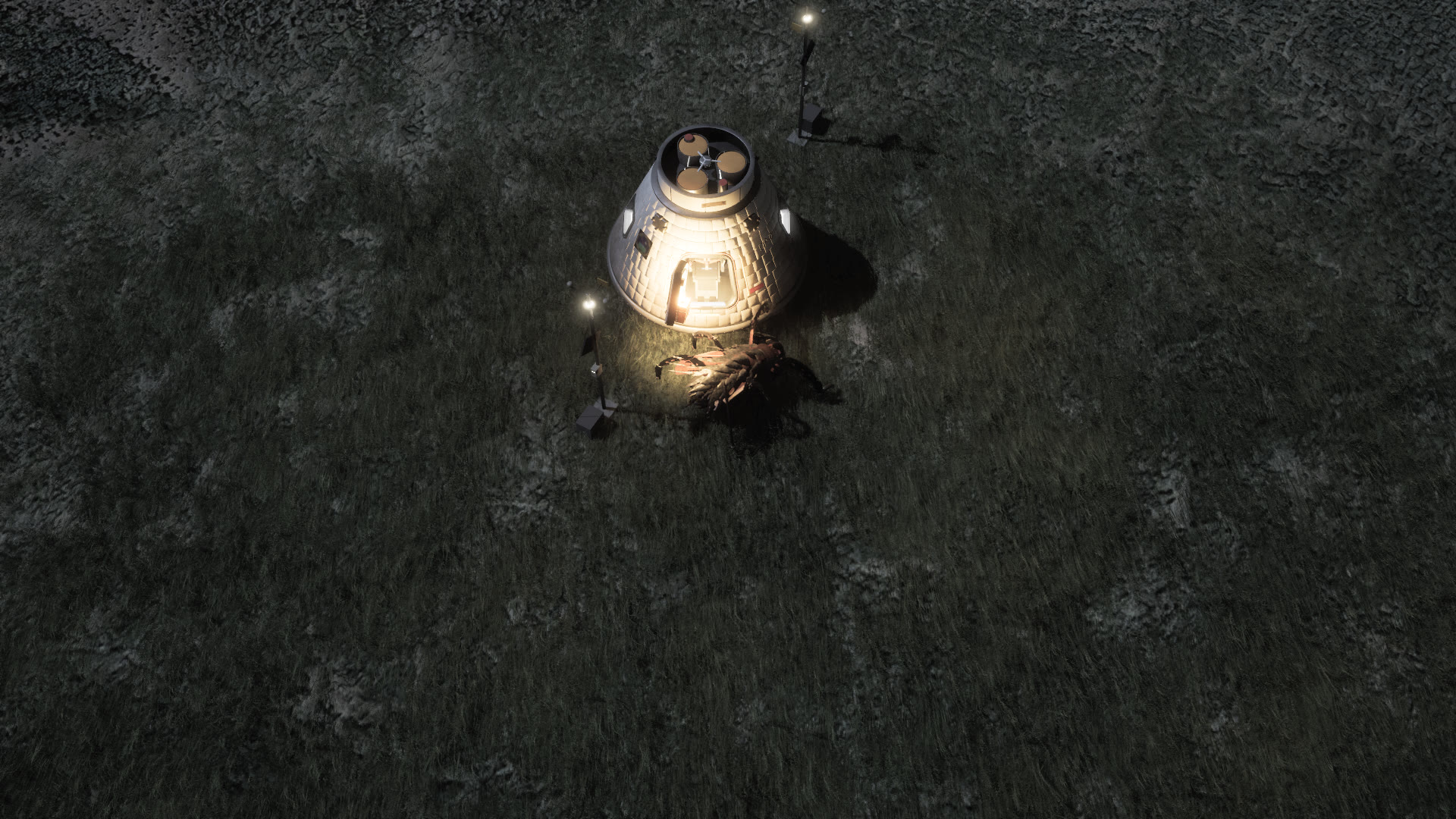
    Real-time footage from a fixed camera above the drop pod. Silent. The night's shadows are lifted a little so it can be seen.

  • Arrival over Nova Eridani

03Parametric construction

Build it brick by brick

Foundations that follow the slope, walls laid in real bonds, timber frames, windows, doors, roofs and skylights. Anything can be taken down again.

Bonded corners, mortared joints, walls that carry their bond on, and single bricks you can lay one at a time, cut to whole, three-quarter, half or closer.

The corner of a red-brick cottage with white-framed windows and a shingled gable roof, standing in long grass.In development
Corners bonded brick by brick, course by course.
Close view along a brick wall in stretcher bond, mortar joints between every brick, a white window frame at the right.In development
Every brick laid in bond, every joint mortared.
Close-up of the axe head: blackened forged steel stamped NOVA ERIDANI with an NE roundel, the edge polished bright.Model render
Stamped at the forge.

04The First Industry

An industry that runs itself

Every robot is printed in a fabricator, then put to work. The settlement runs whether or not you are watching, and every slowdown has a visible cause.

A robot planting saplings near a forester station on a coastal slope.
In development

Work building · 01 of 09

Forester

Foresters plant the trees the woodcutters will fell.

Foresters plant.

05After dark

Keep to the light

When the sun goes down, something comes out of the dark, and you cannot outrun it. You can hear it, though, and you can see it coming. Get to the light.

Solar arrays by day, batteries for the night, and street lights that come on by themselves at dusk. When power runs short, the lights stay on first.

After dark · recorded in game

Real-time footage from a fixed camera above the drop pod. Silent. The night's shadows are lifted a little so it can be seen.

New in the test build

SchematicThe visor's motion disc and Melanie's nightfall countdown, drawn for this site. Not a capture of the game's interface.

In the test build

06Another sky · in the test build

Ten light years on, the same stars

Look up on a clear night and the stars are the real ones, seen from 10.5 light years away: old constellations bent out of shape, the Sun just one more star, the Milky Way overhead, two moons, and the Meridian crossing on her orbit.

Playable in development builds

Most stars are so far away that ten light years changes nothing. The near ones move. Switch the sky between Earth and Nova Eridani and watch them go: Epsilon Eridani leaves the sky, because there it is the sun, and the Sun appears in its place on the far side, an ordinary star in Serpens.

Stars plotted
6,345
The Sun from here
Magnitude 2.4
Sirius
Brighter still
Moons
Luma · Kest

Plotting the sky…

Brightness (magnitude: lower is brighter)
StarFrom EarthFrom here

Looking straight up from the landing site, 42° north; east is on the left, as on a chart held overhead. Drag to turn the sky. Drawn for this site from the game's own star data: the Hipparcos catalogue (ESA), and the Milky Way from ESO/S. Brunier.

07The Meridian's intelligence

Meet Melanie

The Meridian's intelligence has been alone and blind for six years. Give her back her senses and she can finally show herself: a hologram beside your cradle, then a companion through your visor wherever you go.

08Development log

Notes from development

Development

A home in the habitat

Test build 0.1.403: the habitat from the care package is furnished as a home, with smart glass, lights on the colony's power, a working colony terminal, a bunk, a chair, a shower and a toilet, each with its own animation and seen by the crew in co-op.

Development

Told by Melanie

Test build 0.1.385: the opening film rewritten and told by Melanie, with new scenes inside Genesis's holds and out in the trial bay, a reworked bomb, and a fly-in to the Meridian the first time the title screen opens.

Development

Your game on Discord

Test build 0.1.393: your friends on Discord see the mission you are on and where you are, with a picture for each place. Voices, music, sound effects and menu sounds each have their own volume, and the opening film's narration plays at the right level.

Development

The way down

Test build 0.1.381: Nova Eridani from orbit as the opening film shows it, the ship coming down to a deployment orbit, a rebuilt pod bay, and the drop pod's launch as a short film. In the opening film, ships that leave their docks on their thrusters.

Private testing · Steam page later

Follow the expedition

A private beta for a small group of testers is being set up, and the store page will follow. Until then, every change is written up in the development log, with an RSS feed so you never miss one.

Nova Eridani is in development. Showcase 01 — “Arrival” is in private testing. Screenshots are from the in-development build.